
Microwave Rubber Mould Preheating Systems
Kerone is an organization that helps the rubber manufactures and processors with its high quality and technically advanced electromagnetic based heating solution powered by microwave heating.
Engineered precision for Microwave Rubber Mould Preheating Systems.
Kerone is an organization that helps the rubber manufactures and processors with its high quality and technically advanced electromagnetic based heating solution powered by microwave heating. Microwave heating technology has the capability that it penetrates within the rubber material under process and energizes the water molecules present within, this results in very high quality processing in shorter time.
As rubber is a poor conductor to heat, this process is very effective. Our preheating solutions provide great benefit to our clients as the high built quality and technical advancements make our solutions more efficient and economical.
Our advanced AI, ML, and IoT technologies, this solution delivers smarter automation, real-time insights, and predictive intelligence to enhance efficiency and drive future-ready growth.
Continuous tracking of process parameters with instant adjustments.
Intelligent fault detection to prevent failures before they occur.
Dynamic tuning of operations for maximum output and efficiency.
The thermodynamic architecture of our Microwave Rubber Mould Preheating Systems incorporates advanced thermal modeling and computational fluid dynamics (CFD) to ensure optimal heat and mass transfer across the entire processing zone. By precisely controlling thermal gradients, air velocity profiles, and direct energy delivery mechanisms, the system achieves uniform treatment while preventing localized overheating, product degradation, or thermal stress. This balance of intensive heat transfer and controlled retention time ensures maximum operational throughput with minimal specific energy consumption.
Built with heavy-duty structural engineering and sanitary metallurgy, each unit is manufactured to withstand continuous 24/7 industrial operating conditions. Contact surfaces are finished in high-grade stainless steel (SS 304, SS 316L, or corrosion-resistant alloys) with sanitary mirror-polish options, CIP/SIP washdown provisions, and hermetic chamber sealing. This guarantees full compliance with stringent international hygiene, CE machinery directives, and cGMP standards across food, pharmaceutical, specialty chemical, and heavy manufacturing applications.
Proprietary control algorithms ensure strict process repeatability, while built-in safety interlocks and electromagnetic shielding comply with international CE and OSHA standards. Full process development support — including material loss tangent testing, moisture sorption isotherms, and pilot trials at our Ambernath R&D facility — ensures the selected technology matches your exact industrial throughput goals.
Product & Systems Gallery
Explore authentic high-resolution photographs of industrial machinery, pilot trial rigs, and continuous turnkey processing installations engineered by Kerone Engineering Solutions for Microwave Rubber Mould Preheating Systems. Each system is fabricated at our ISO 9001:2015 certified manufacturing facilities with precision laser cutting, robotic welding, and stringent Factory Acceptance Testing (FAT).
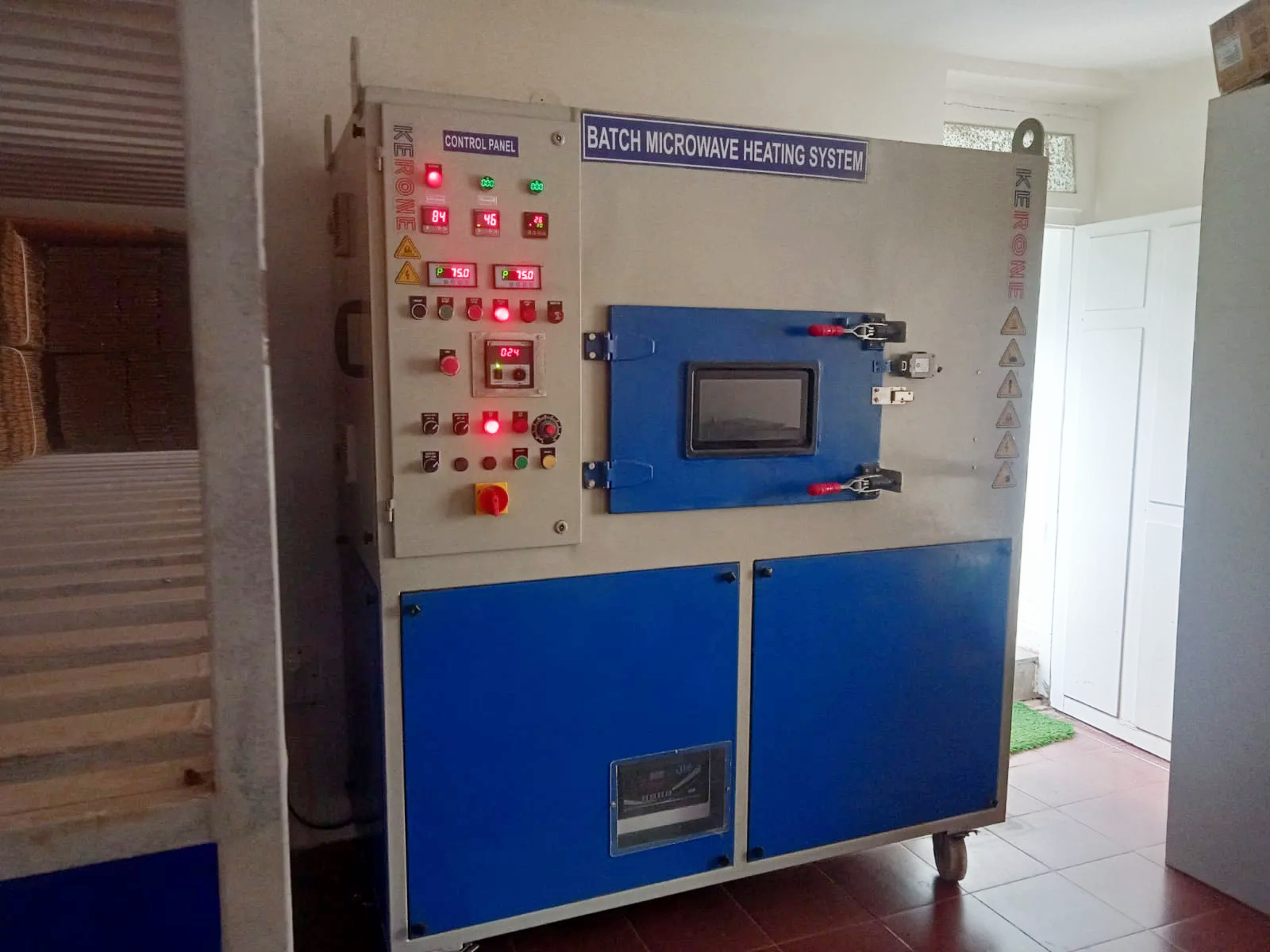
Microwave Rubber Mould Preheating Systems
Click to view high-res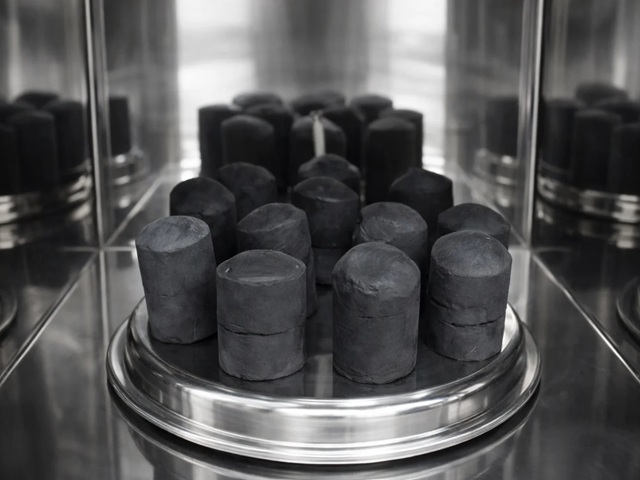
Microwave Rubber Mould Preheating Systems
Click to view high-res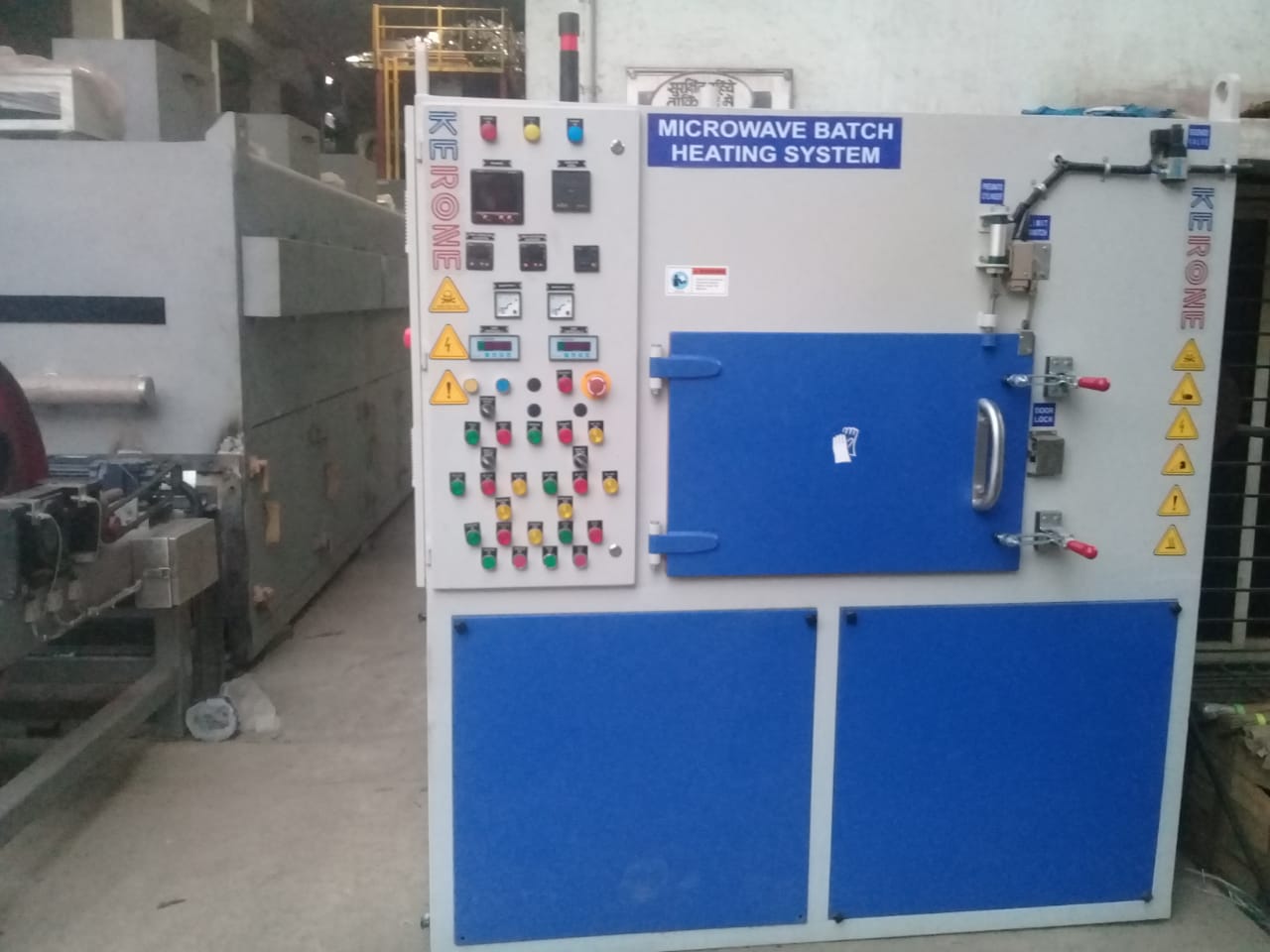
Microwave Rubber Mould Preheating Systems
Click to view high-res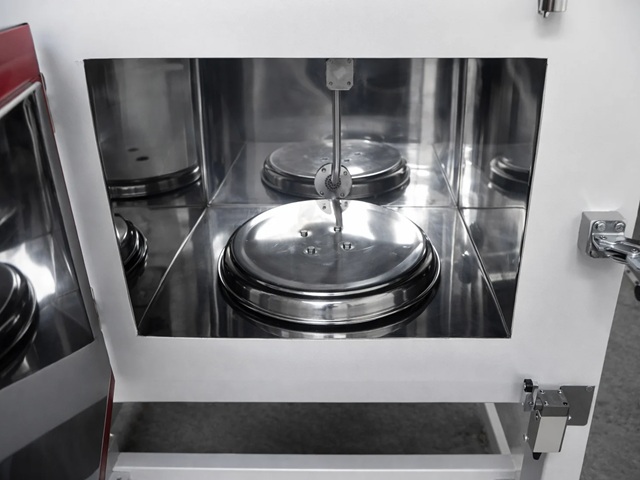
Microwave Rubber Mould Preheating Systems
Click to view high-res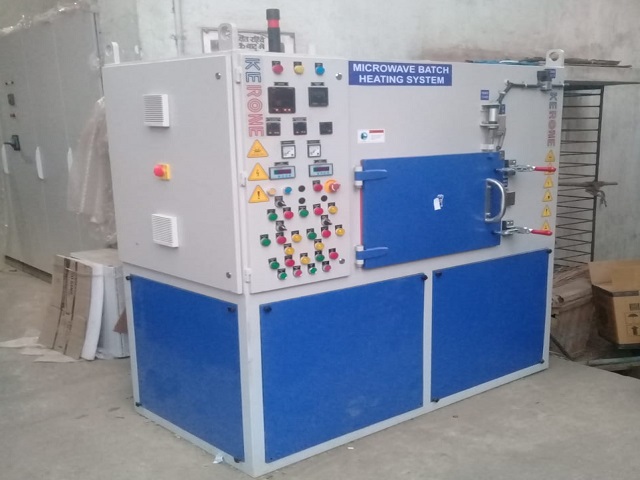
Microwave Rubber Mould Preheating Systems
Click to view high-res
Microwave Rubber Mould Preheating Systems
Click to view high-res50+ Years of Thermal Engineering Leadership.
Since 1976, Kerone Engineering Solutions has delivered over 5,000 custom-engineered thermal and process installations across 50+ countries. In technical collaboration with premier global institutions like CSIR-CEERI and University of Nottingham research partnerships, we design and manufacture high-efficiency machinery that minimizes production downtime and cuts operating expenses.
Unlike standard off-the-shelf equipment suppliers, Kerone operates a complete pilot-scale testing facility at our KRDC Ambernath center. We validate your exact raw material properties — determining moisture sorption isotherms, specific heat capacity, and dielectric behavior — before finalizing equipment sizing, ensuring zero risk during industrial scale-up.
Engineering precision, built into every system.
High Thermal and Processing
High thermal and processing efficiency
Low Maintenance and Easy
Low maintenance and easy operation
Suitable
Suitable for heat-sensitive materials
Fully Adjustable and
Fully adjustable and customizable process parameters
Available in Batch and
Available in batch and continuous configurations
Uniform Processing and
Uniform processing and consistent product quality
Powered by AI, Machine Learning & Smart IoT Integration
Modern industrial processing requires unprecedented thermal precision, energy efficiency, and operational agility. Kerone equips each system with high-speed industrial edge computing controllers, multi-spectral non-contact infrared pyrometry, and proprietary closed-loop machine learning algorithms that continuously analyze process parameters in real time.
The intelligent automation stack monitors dynamic changes in incoming material load, bed thickness, moisture content, and environmental factors. In response, our algorithms dynamically adjust heater power arrays, generator frequency, conveyor drive velocities, and exhaust dampers within milliseconds — entirely eliminating product burn, under-processing, or thermal hotspotting.
Seamlessly integrated with factory-wide SCADA and enterprise ERP architectures via native MQTT, OPC-UA, and Modbus TCP protocols, our systems deliver complete digital recipe control, remote diagnostics, predictive maintenance alerting, and tamper-evident batch logs compliant with global FDA 21 CFR Part 11 and cGMP standards.
Adaptive Heat Modulation
Neural algorithms detect material thermal variations in real time (<50ms response) and tune generator frequency and power arrays automatically.
IoT Cloud Telemetry
Continuous bidirectional telemetry stream via MQTT/OPC-UA protocols directly to centralized plant SCADA, MES, or mobile engineer dashboards.
Predictive Maintenance
Monitors magnetron cathode current, vibration frequency signatures, and differential filter pressure to schedule AMC maintenance before failures occur.
Quality & Batch Traceability
Automated digital recipe execution, multi-stage temperature ramp/soak curves, and cryptographically signed electronic batch logs compliant with 21 CFR Part 11.
Engineered for High-Value Industrial Sectors
Tailored thermal and process configurations across continuous manufacturing lines.
Preheating rubber preforms for comp...
Preheating rubber preforms for compression moulding of automotive rubber components
Rubber blank preheating for transfe...
Rubber blank preheating for transfer moulding of seals, gaskets, and O-rings
Silicone rubber preform preheating ...
Silicone rubber preform preheating for medical and food-grade moulded components
Industrial rubber component preheat...
Industrial rubber component preheating for large compression-moulded parts
Vibration damper and rubber
to: metal bonded component preform preheating
Rubber mat and sheet compression mo...
Rubber mat and sheet compression moulding preheating applications
Configured to Your Process Window
Technical parameter envelopes across industrial manufacturing and engineering architectures.
Frequently Asked Questions
Engineering answers regarding equipment sizing, integration, and process performance.
It is used for efficient processing, heating, drying or material transformation.
High efficiency, process reliability and complete customization.
Yes, Kerone offers fully customized engineering solutions.
Food, chemical, pharma, biomass, rubber, textile and more.
Kerone ensures high product quality through strict engineering standards, advanced testing procedures, and precision-controlled manufacturing systems.
With properly controlled microwave power and preheating time, scorching is prevented. Kerone's systems include automatic temperature monitoring and power cutoff to prevent overheating.
Natural rubber, EPDM, NBR, SBR, silicone, neoprene, and other standard moulding compounds can be preheated, with parameters adjusted for each compound's specific dielectric and thermal properties.
Properly preheated rubber preforms typically reduce press cycle time by 30–50%, depending on the part geometry, rubber compound, and initial preform temperature.
Rubber is a naturally poor conductor of heat, which means that in conventional press heating, the mould surface reaches curing temperature long before the rubber's core does. This forces manufacturers to hold the press closed longer to let heat conduct fully through the part, wasting press time. Microwave preheating solves this by exciting moisture and polar molecules throughout the rubber preform before it ever enters the press, bringing the entire mass close to a uniform target temperature in a separate, parallel step. When the preform reaches the mould already warm and uniform, the press only needs to complete cross-linking rather than also performing the slow job of heating the rubber from the outside in, which is why preheated stock can cut total press cycle time by roughly 30 to 50 percent depending on part geometry and compound.
Natural rubber, EPDM, NBR, SBR, neoprene, and silicone all preheat effectively because each contains enough polar content or moisture to couple with microwave energy, though the optimal power and exposure time differs by compound due to varying dielectric loss factors. Compounds with very low polarity or minimal moisture content respond more slowly and may need longer exposure or supplemental heating to reach target preheat temperature. Filler content also matters, since carbon black and certain mineral fillers can alter how energy distributes through the preform. Manufacturers switching between multiple compound families should expect to run trial batches to establish power and time settings for each formulation, since a setting optimized for EPDM will not transfer directly to silicone without adjustment.
Scorching occurs when localized areas of the rubber preform absorb energy faster than heat can dissipate, typically due to uneven preform geometry, inconsistent compound mixing, or excessive power applied for too long a duration. Kerone's systems address this through automatic temperature monitoring combined with power cutoff logic that halts or reduces energy input once target temperature is reached, rather than running a fixed time cycle regardless of actual preform temperature. Turntable or conveyor-based positioning also helps by continuously repositioning the preform within the microwave field, preventing any single zone from absorbing a disproportionate energy dose. Proper preform sizing and consistent compound mixing upstream further reduce scorch risk, since irregular shapes are more prone to hot-spot formation than uniform geometries.
Batch preheaters are well suited to operations producing a variety of rubber parts in smaller production runs, since each batch can be loaded with a specific compound and preform size, processed, then changed over to the next product without disrupting a continuous line. Continuous systems suit high-volume single-product manufacturing, such as a dedicated line producing one seal or gasket type at consistent output, because they synchronize preheating with conveyor speed and feed the press without operator intervention between cycles. The decision should be based on product mix variability: facilities running many small-batch SKUs typically get better utilization from batch systems, while facilities running long, repetitive production runs benefit from the throughput consistency of continuous configurations integrated directly into the moulding line.
Because microwave preheating brings the rubber preform to a uniform temperature throughout its mass before moulding, the resulting parts typically show more consistent cure state from surface to core, reducing the porosity and internal voids that occur when undercured cores trap volatiles during press closure. This uniformity also reduces dimensional variation between parts, since uneven shrinkage from inconsistent cure is minimized. Surface finish quality improves as well, since preheated stock flows more predictably into mould cavities, reducing short-shot defects in complex geometries. Manufacturers moulding technical rubber components with tight tolerance requirements, such as automotive seals or vibration dampers, often see scrap rate reductions as a direct result of this improved cure consistency.
Microwave preheating shifts a portion of the heating workload away from the press itself, which is typically the most energy-intensive station in a moulding line because it must maintain high temperature for extended dwell times. By moving a meaningful share of heat input to a microwave preheater operating on direct electrical coupling rather than conduction through steel mould platens, total energy consumption per part often decreases even though a new piece of equipment has been added. The press also completes its job faster per cycle, meaning it spends less time at full power per part produced. The net effect for most rubber processors is a reduction in combined energy cost per finished part, though the exact savings depend on existing press efficiency and the specific compound and part geometry being run.
Yes, microwave rubber mould preheaters are generally designed as standalone units positioned between the preform preparation stage and the moulding press, which means they can typically be integrated into an existing line layout with moderate modification rather than a full redesign. The main physical considerations are floor space for the preheater itself, conveyor or transfer mechanism alignment with the existing press infeed, and electrical supply capacity to support the microwave generator. Facilities with constrained floor space should discuss compact cavity designs with their supplier during the specification stage, since preheater footprint varies based on rated throughput and preform size range.
Let’s Engineer the Right Process.
From application trials to full-scale production systems, our engineering team works with you to develop the right thermal processing solution for your material, throughput, and production requirements.