
Microwave Heating For Wood
Microwave pre-treatment is a technique to improve process efficiency and product performance of wood in the forest product industry.
Engineered precision for Microwave Heating For Wood.
Microwave pre-treatment is a technique to improve process efficiency and product performance of wood in the forest product industry. High-intensity microwave pre-treatment for wood modification originated from Australia at the end of last century, in which water in wood absorbed enough energy from the transient electromagnetic wave and turned into steam.
High internal steam pressure destructed the weaker elements of wood and the micro voids in the radial-longitudinal planes of wood were created, which puffed wood into loose structure, increased wood permeability, and improved the drying process. Some studies reported that several properties of wood were improved after microwave pre-treatment.
Our advanced AI, ML, and IoT technologies, this solution delivers smarter automation, real-time insights, and predictive intelligence to enhance efficiency and drive future-ready growth.
Continuous tracking of process parameters with instant adjustments.
Intelligent fault detection to prevent failures before they occur.
Dynamic tuning of operations for maximum output and efficiency.
The thermodynamic architecture of our Microwave Heating For Wood incorporates advanced thermal modeling and computational fluid dynamics (CFD) to ensure optimal heat and mass transfer across the entire processing zone. By precisely controlling thermal gradients, air velocity profiles, and direct energy delivery mechanisms, the system achieves uniform treatment while preventing localized overheating, product degradation, or thermal stress. This balance of intensive heat transfer and controlled retention time ensures maximum operational throughput with minimal specific energy consumption.
Built with heavy-duty structural engineering and sanitary metallurgy, each unit is manufactured to withstand continuous 24/7 industrial operating conditions. Contact surfaces are finished in high-grade stainless steel (SS 304, SS 316L, or corrosion-resistant alloys) with sanitary mirror-polish options, CIP/SIP washdown provisions, and hermetic chamber sealing. This guarantees full compliance with stringent international hygiene, CE machinery directives, and cGMP standards across food, pharmaceutical, specialty chemical, and heavy manufacturing applications.
Proprietary control algorithms ensure strict process repeatability, while built-in safety interlocks and electromagnetic shielding comply with international CE and OSHA standards. Full process development support — including material loss tangent testing, moisture sorption isotherms, and pilot trials at our Ambernath R&D facility — ensures the selected technology matches your exact industrial throughput goals.
Product & Systems Gallery
Explore authentic high-resolution photographs of industrial machinery, pilot trial rigs, and continuous turnkey processing installations engineered by Kerone Engineering Solutions for Microwave Heating For Wood. Each system is fabricated at our ISO 9001:2015 certified manufacturing facilities with precision laser cutting, robotic welding, and stringent Factory Acceptance Testing (FAT).
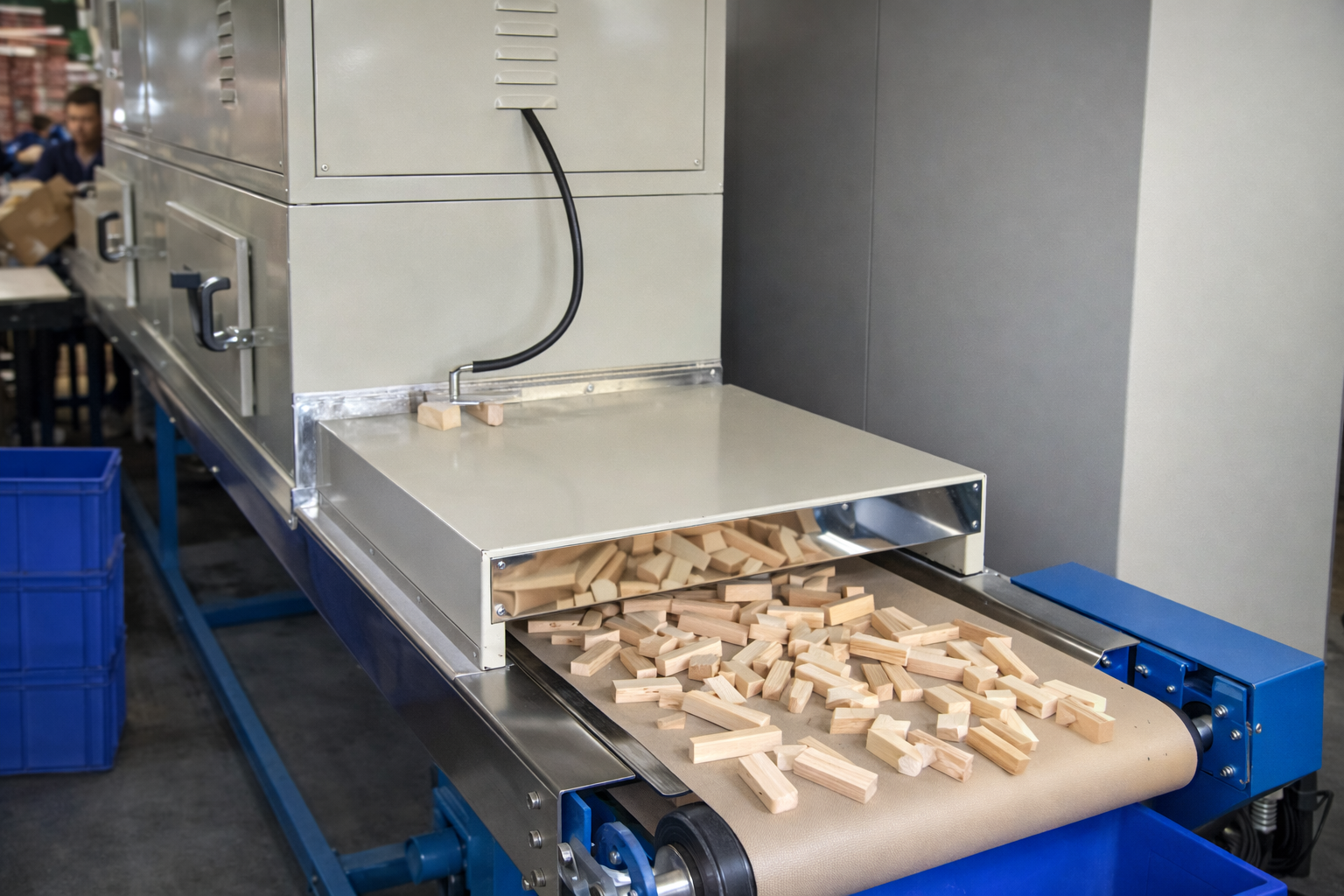
Microwave Heating For Wood
Click to view high-res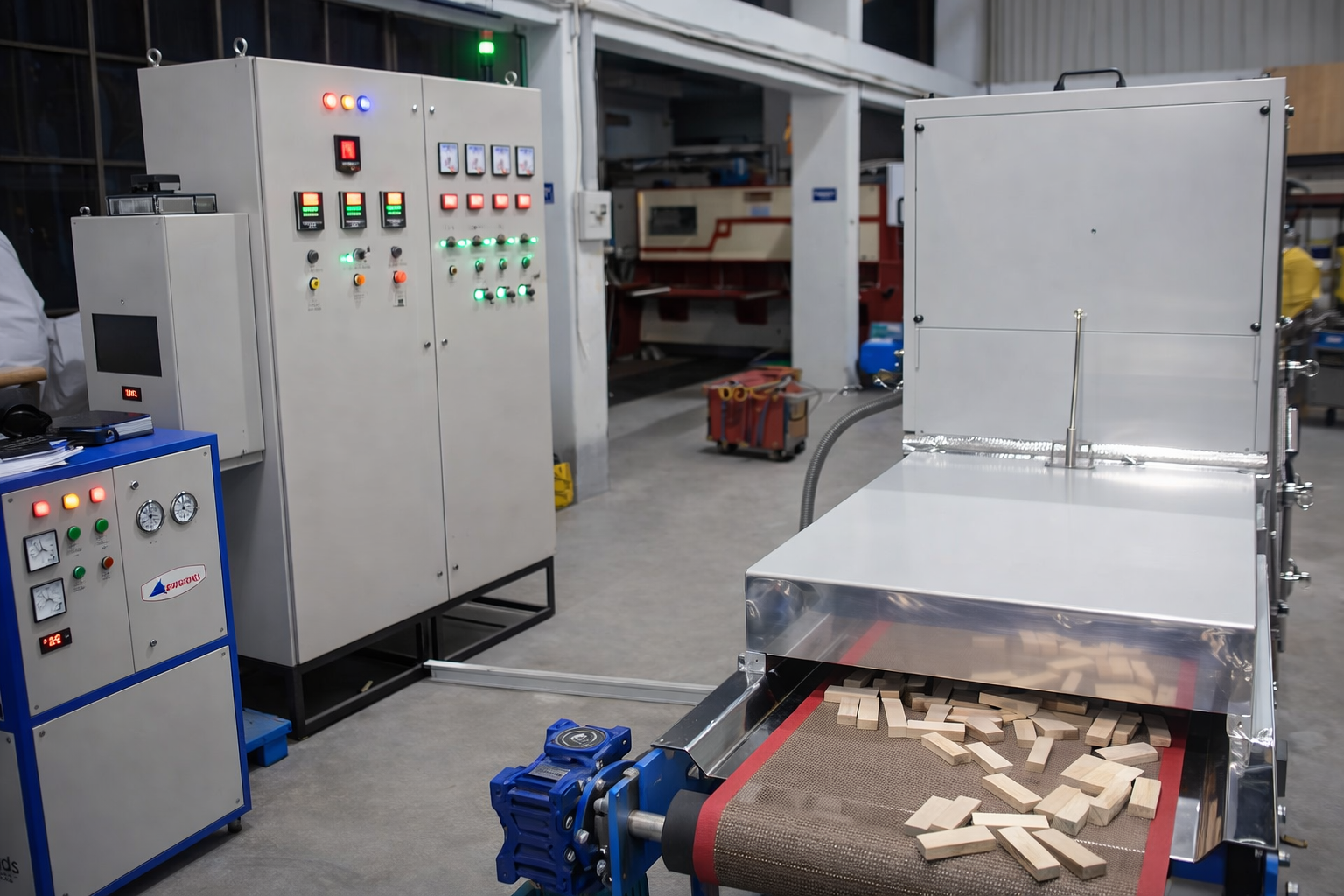
Microwave Heating For Wood
Click to view high-res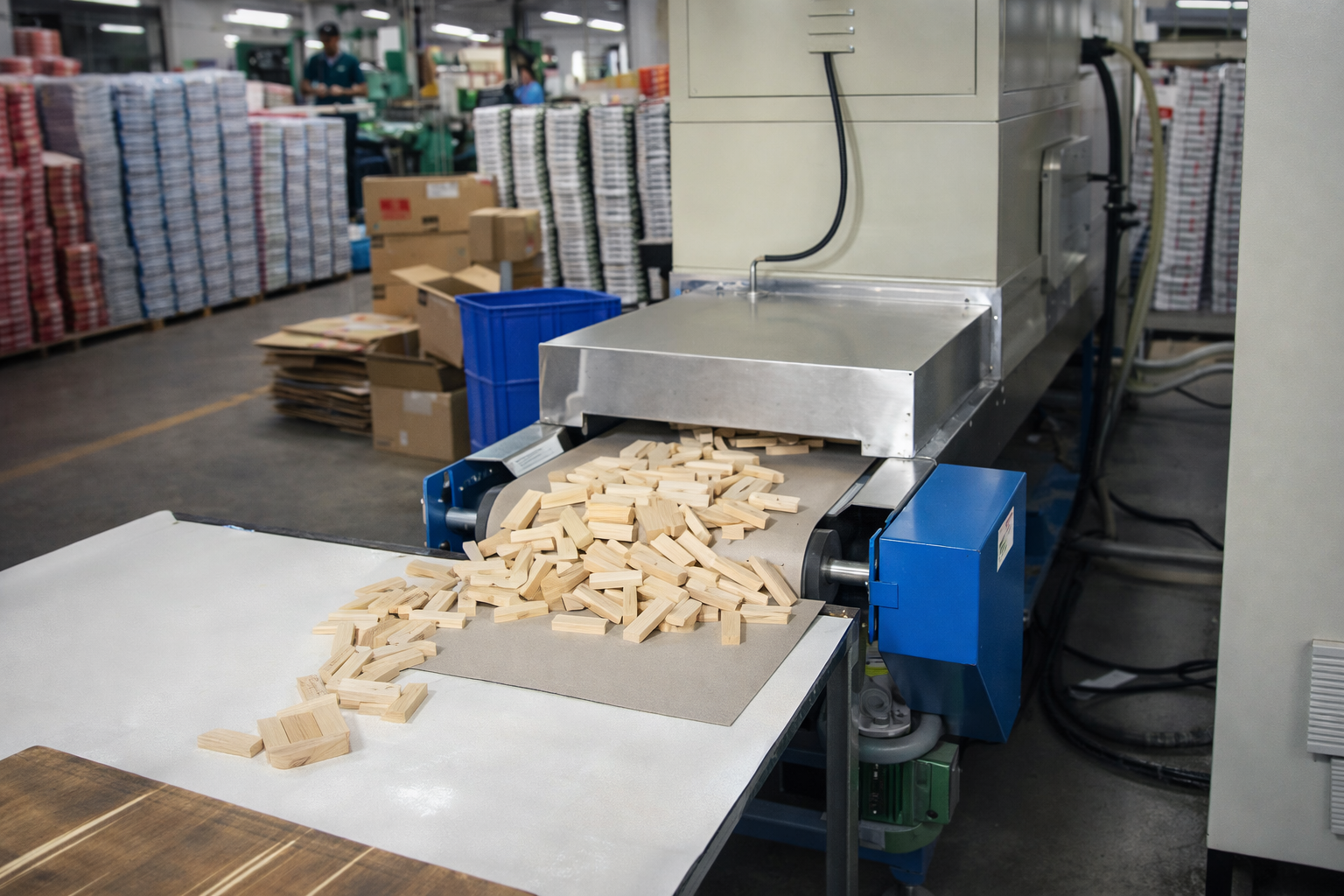
Microwave Heating For Wood
Click to view high-res
Microwave Heating For Wood
Click to view high-res
Microwave Heating For Wood
Click to view high-res
Microwave Heating For Wood
Click to view high-res50+ Years of Thermal Engineering Leadership.
Since 1976, Kerone Engineering Solutions has delivered over 5,000 custom-engineered thermal and process installations across 50+ countries. In technical collaboration with premier global institutions like CSIR-CEERI and University of Nottingham research partnerships, we design and manufacture high-efficiency machinery that minimizes production downtime and cuts operating expenses.
Unlike standard off-the-shelf equipment suppliers, Kerone operates a complete pilot-scale testing facility at our KRDC Ambernath center. We validate your exact raw material properties — determining moisture sorption isotherms, specific heat capacity, and dielectric behavior — before finalizing equipment sizing, ensuring zero risk during industrial scale-up.
Engineering precision, built into every system.
High Thermal and Processing
High thermal and processing efficiency
Low Maintenance and Easy
Low maintenance and easy operation
Suitable
Suitable for heat-sensitive materials
Fully Adjustable and
Fully adjustable and customizable process parameters
Available in Batch and
Available in batch and continuous configurations
Uniform Processing and
Uniform processing and consistent product quality
Powered by AI, Machine Learning & Smart IoT Integration
Modern industrial processing requires unprecedented thermal precision, energy efficiency, and operational agility. Kerone equips each system with high-speed industrial edge computing controllers, multi-spectral non-contact infrared pyrometry, and proprietary closed-loop machine learning algorithms that continuously analyze process parameters in real time.
The intelligent automation stack monitors dynamic changes in incoming material load, bed thickness, moisture content, and environmental factors. In response, our algorithms dynamically adjust heater power arrays, generator frequency, conveyor drive velocities, and exhaust dampers within milliseconds — entirely eliminating product burn, under-processing, or thermal hotspotting.
Seamlessly integrated with factory-wide SCADA and enterprise ERP architectures via native MQTT, OPC-UA, and Modbus TCP protocols, our systems deliver complete digital recipe control, remote diagnostics, predictive maintenance alerting, and tamper-evident batch logs compliant with global FDA 21 CFR Part 11 and cGMP standards.
Adaptive Heat Modulation
Neural algorithms detect material thermal variations in real time (<50ms response) and tune generator frequency and power arrays automatically.
IoT Cloud Telemetry
Continuous bidirectional telemetry stream via MQTT/OPC-UA protocols directly to centralized plant SCADA, MES, or mobile engineer dashboards.
Predictive Maintenance
Monitors magnetron cathode current, vibration frequency signatures, and differential filter pressure to schedule AMC maintenance before failures occur.
Quality & Batch Traceability
Automated digital recipe execution, multi-stage temperature ramp/soak curves, and cryptographically signed electronic batch logs compliant with 21 CFR Part 11.
Engineered for High-Value Industrial Sectors
Tailored thermal and process configurations across continuous manufacturing lines.
Food industry processing systems
Food industry processing systems
Chemical and polymer processing
Chemical and polymer processing
Pharmaceutical ingredients and inte...
Pharmaceutical ingredients and intermediates
Ready‑to‑eat (RTE) food production
Ready‑to‑eat (RTE) food production
Specialized heating, drying, or mat...
Specialized heating, drying, or material transformation processes
Industrial material modification an...
Industrial material modification and thermal treatment
Configured to Your Process Window
Technical parameter envelopes across industrial manufacturing and engineering architectures.
Frequently Asked Questions
Engineering answers regarding equipment sizing, integration, and process performance.
It is used for efficient processing, heating, drying or material transformation.
High efficiency, process reliability and complete customization.
Yes, Kerone offers fully customized engineering solutions.
Food, chemical, pharma, biomass, rubber, textile and more.
Kerone ensures high product quality through strict engineering standards, advanced testing procedures, and precision-controlled manufacturing systems.
No, when properly controlled, microwave heating preserves the wood’s structural integrity and reduces internal stress compared to traditional methods.
It is commonly used for drying, seasoning, pest control, resin curing, and improving dimensional stability of wood products.
Unlike conventional hot air drying, microwave heating penetrates deep into the wood, resulting in faster drying, reduced cracks, and improved moisture control.
Microwave heating applications in wood processing extend to foaming and structural modification of wood for permeability enhancement, adhesive curing in engineered wood products, accelerating wood bending processes for furniture and architectural components, and moisture removal combined with sterilization to prevent mold growth during storage. The sterilization and disinfestation effect of microwave treatment is a notable secondary benefit, since the same heating process that removes moisture also addresses fungal spores and wood-boring insects that can compromise wood quality during extended storage or shipping, extending the usable shelf life of processed wood products beyond what drying alone would provide.
When properly controlled, the steam pressure generated during microwave pretreatment is calibrated to create beneficial micro-void formation without causing the macroscopic cracking or checking that uncontrolled rapid drying can produce in conventional kiln operations. The process actually tends to reduce certain types of internal stress compared to traditional drying methods, since the engineered permeability increase allows more even moisture migration during subsequent drying stages, reducing the moisture content gradients between a board's surface and core that are a primary cause of warping and checking in conventionally dried lumber. Process parameters need to be matched to wood species and initial moisture content, since species with different density and permeability characteristics respond differently to the same power and exposure settings.
Microwave heating can dry wood considerably faster than conventional air-circulation methods because energy penetrates directly into the wood's internal moisture rather than relying on the comparatively slow process of moisture migrating to the surface through natural capillary action before evaporating into circulated air. This speed advantage becomes more pronounced for thicker wood sections or for wood with naturally low permeability, where conventional drying times can stretch significantly. For certain pretreatment applications, such as preparing wood for pyrolysis processing, complete treatment can be achieved in as little as ten to fifteen minutes using microwave technology, compared to substantially longer timeframes required by conventional thermal methods applied to equivalent wood volumes.
One practical advantage of microwave wood treatment is the ability to process larger pieces of wood than some conventional rapid-drying alternatives can handle effectively, since the volumetric heating mechanism does not depend on heat conducting in from the surface as it does in many conventional intensive drying methods. This makes microwave technology applicable across a range of wood product types, from rough sawn lumber requiring moisture conditioning to finished components needing precise final moisture adjustment before assembly. The appropriate system configuration depends on the specific wood dimensions, species density, and target outcome, whether that is bulk moisture reduction, pretreatment for downstream processing, or precision conditioning for high-value finished products.
Microwave energy heats the moisture trapped within wood cells rapidly, converting it to steam faster than it can escape through the wood's natural permeability. This generates internal steam pressure that mechanically weakens and ruptures cell wall structures, particularly along the radial-longitudinal planes, creating microscopic voids throughout the wood. This puffed, more permeable structure is the key benefit of microwave pretreatment, since increased permeability allows moisture to migrate out of the wood far more readily during subsequent drying stages than would be possible with the wood's original dense cellular structure. The technique essentially opens pathways for moisture movement before conventional drying begins, which is why it functions as a pretreatment step rather than a complete standalone drying solution in most applications.
Yes, when wood has already been dried to around 10 percent moisture content using conventional methods, further dehydration with traditional air-circulation or kiln drying becomes increasingly slow and inefficient, since the remaining bound moisture is held tightly within the wood's cellular structure. Microwave drying can continue reducing moisture content beyond this point more effectively because the energy targets remaining water molecules directly rather than relying on the diminishing moisture gradient that drives conventional drying. This makes microwave technology particularly useful as a finishing step for applications requiring very low final moisture content, such as wood destined for fine furniture or precision joinery where dimensional stability depends on minimizing residual moisture beyond what standard kiln drying typically achieves.
Wood processed with microwave pretreatment or finishing typically shows improved dimensional stability due to more even moisture distribution, reduced incidence of checking and warping that result from uneven drying stresses, and the added benefit of reduced mold risk during storage due to the sterilization effect of the heating process. For wood destined for furniture, joinery, or other applications where precise final dimensions and surface quality matter significantly, these improvements can reduce downstream processing rejects and improve the consistency of finished product quality. Processors working with premium wood species or high-value finished applications often find these quality improvements justify the additional processing step even when bulk drying time savings alone might not fully justify the investment.
Let’s Engineer the Right Process.
From application trials to full-scale production systems, our engineering team works with you to develop the right thermal processing solution for your material, throughput, and production requirements.