
Batch Microwave Heating System
Batch Microwave Heating Systems are versatile industrial microwave processing units that heat, dry, cure, or sterilize discrete quantities of material within an enclosed chamber in defined processing cycles.
Engineered precision for Batch Microwave Heating System.
Batch Microwave Heating Systems are versatile industrial microwave processing units that heat, dry, cure, or sterilize discrete quantities of material within an enclosed chamber in defined processing cycles. Unlike continuous systems, batch systems load a specific quantity of product, apply the required microwave heating program, and then unload before the next batch is processed.
This approach offers maximum flexibility in processing diverse product types, sizes, and recipes within the same equipment. Kerone’s batch microwave heating systems are designed for food processing, pharmaceutical manufacturing, chemical processing, material research, and industrial applications where product diversity, smaller production volumes, or highly specific thermal treatments require the flexibility of batch operation.
Our advanced AI, ML, and IoT technologies, this solution delivers smarter automation, real-time insights, and predictive intelligence to enhance efficiency and drive future-ready growth.
Continuous tracking of process parameters with instant adjustments.
Intelligent fault detection to prevent failures before they occur.
Dynamic tuning of operations for maximum output and efficiency.
The thermodynamic architecture of our Batch Microwave Heating System incorporates advanced thermal modeling and computational fluid dynamics (CFD) to ensure optimal heat and mass transfer across the entire processing zone. By precisely controlling thermal gradients, air velocity profiles, and direct energy delivery mechanisms, the system achieves uniform treatment while preventing localized overheating, product degradation, or thermal stress. This balance of intensive heat transfer and controlled retention time ensures maximum operational throughput with minimal specific energy consumption.
Built with heavy-duty structural engineering and sanitary metallurgy, each unit is manufactured to withstand continuous 24/7 industrial operating conditions. Contact surfaces are finished in high-grade stainless steel (SS 304, SS 316L, or corrosion-resistant alloys) with sanitary mirror-polish options, CIP/SIP washdown provisions, and hermetic chamber sealing. This guarantees full compliance with stringent international hygiene, CE machinery directives, and cGMP standards across food, pharmaceutical, specialty chemical, and heavy manufacturing applications.
Proprietary control algorithms ensure strict process repeatability, while built-in safety interlocks and electromagnetic shielding comply with international CE and OSHA standards. Full process development support — including material loss tangent testing, moisture sorption isotherms, and pilot trials at our Ambernath R&D facility — ensures the selected technology matches your exact industrial throughput goals.
Product & Systems Gallery
Explore authentic high-resolution photographs of industrial machinery, pilot trial rigs, and continuous turnkey processing installations engineered by Kerone Engineering Solutions for Batch Microwave Heating System. Each system is fabricated at our ISO 9001:2015 certified manufacturing facilities with precision laser cutting, robotic welding, and stringent Factory Acceptance Testing (FAT).
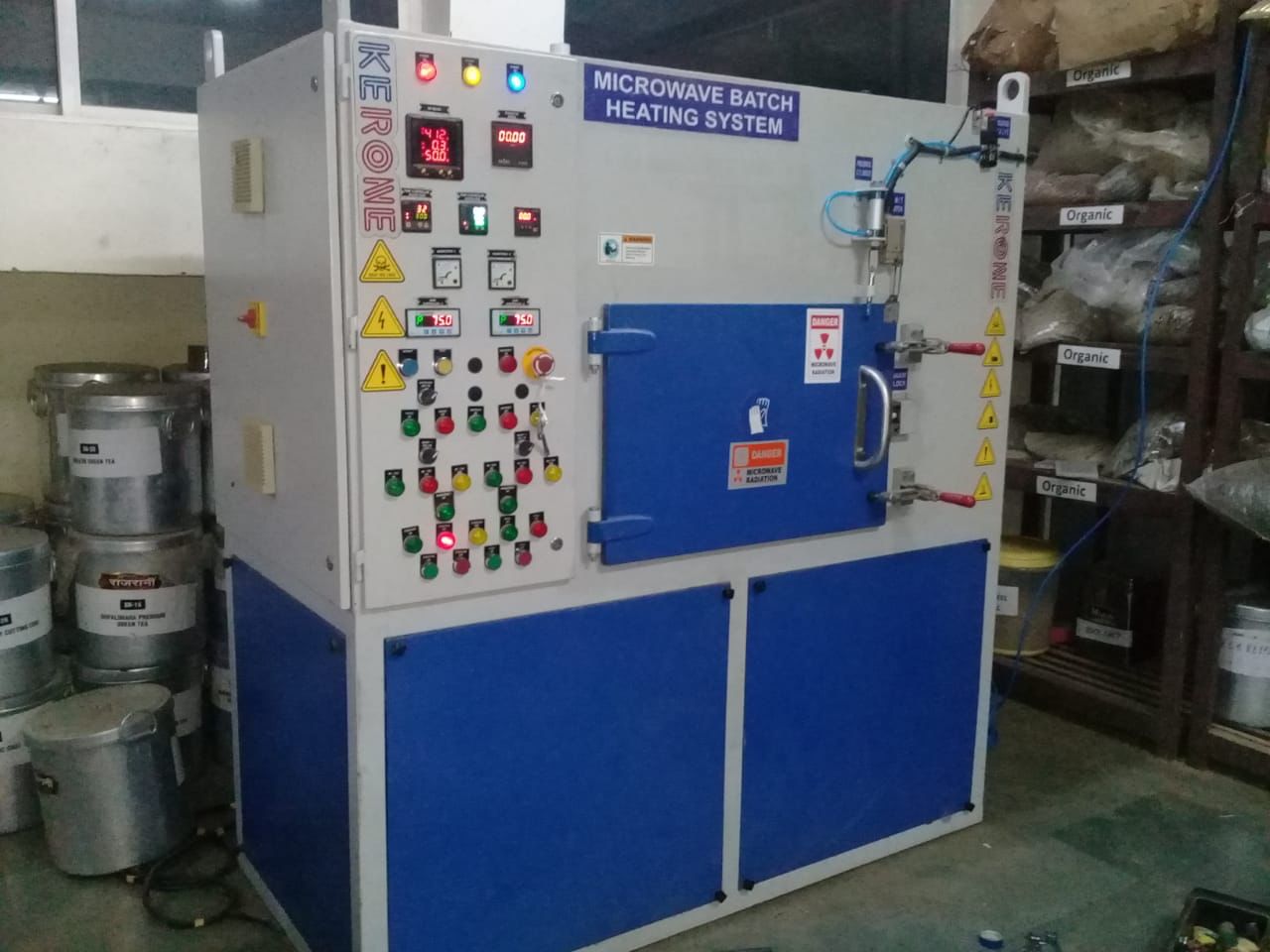
Batch Microwave Heating System
Click to view high-res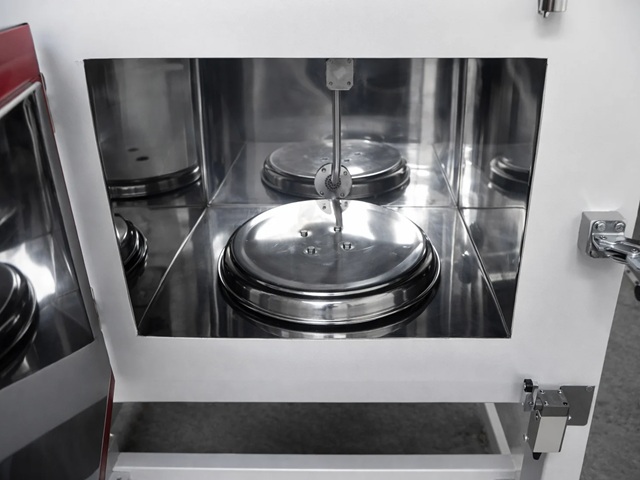
Batch Microwave Heating System
Click to view high-res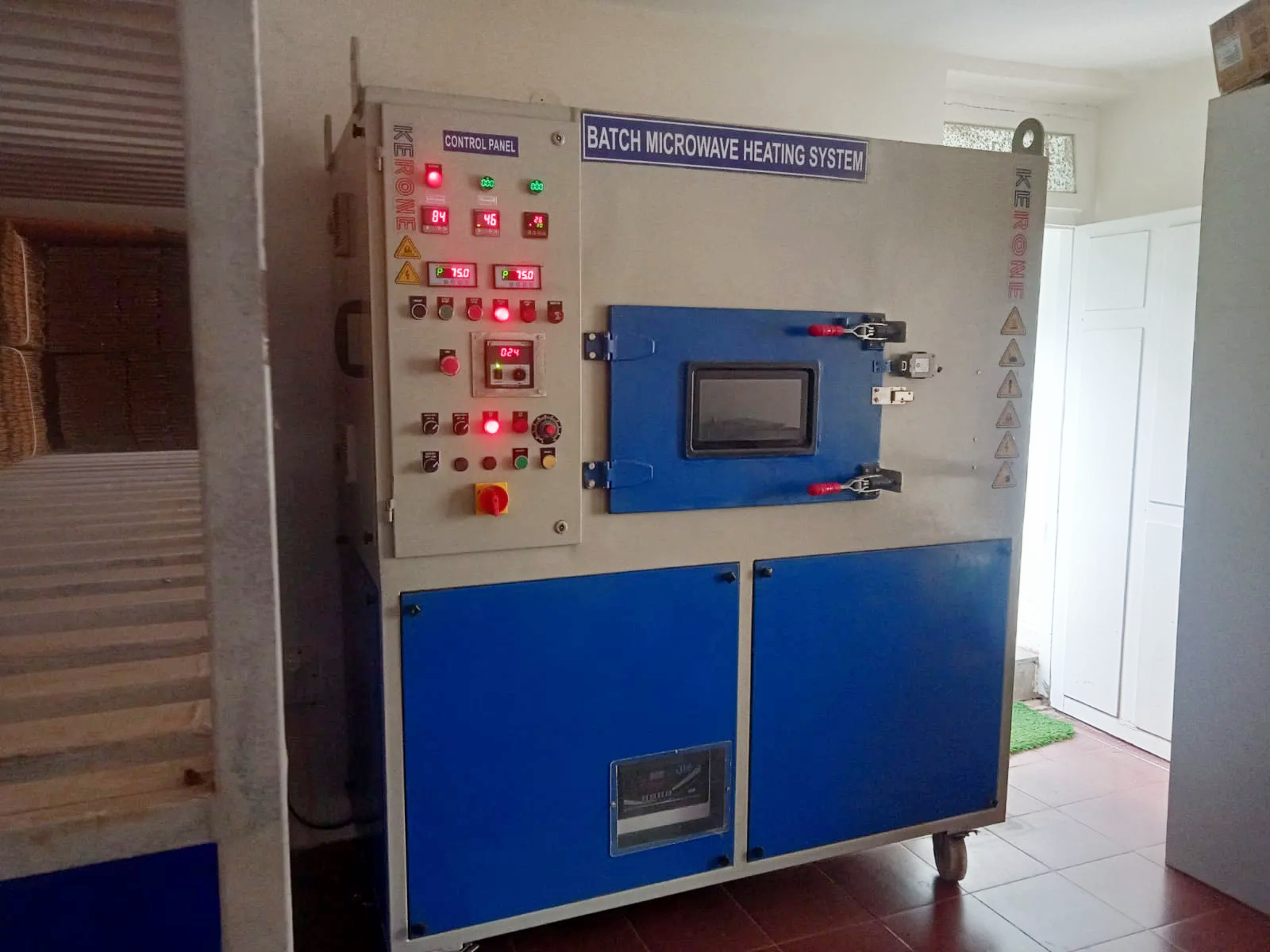
Batch Microwave Heating System
Click to view high-res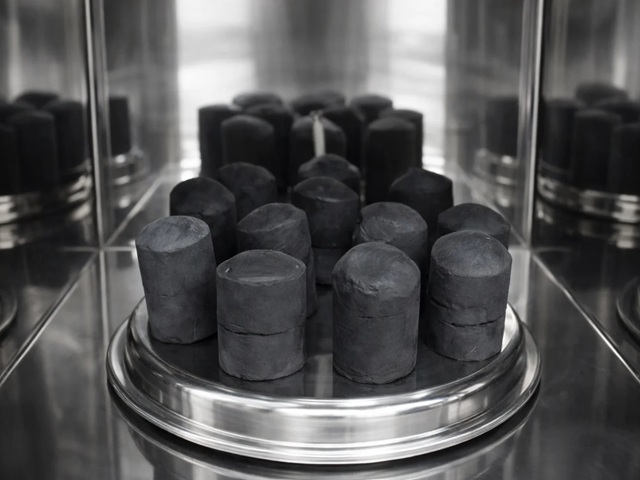
Batch Microwave Heating System
Click to view high-res
Batch Microwave Heating System
Click to view high-res
Batch Microwave Heating System
Click to view high-res50+ Years of Thermal Engineering Leadership.
Since 1976, Kerone Engineering Solutions has delivered over 5,000 custom-engineered thermal and process installations across 50+ countries. In technical collaboration with premier global institutions like CSIR-CEERI and University of Nottingham research partnerships, we design and manufacture high-efficiency machinery that minimizes production downtime and cuts operating expenses.
Unlike standard off-the-shelf equipment suppliers, Kerone operates a complete pilot-scale testing facility at our KRDC Ambernath center. We validate your exact raw material properties — determining moisture sorption isotherms, specific heat capacity, and dielectric behavior — before finalizing equipment sizing, ensuring zero risk during industrial scale-up.
Engineering precision, built into every system.
High Thermal and Processing
High thermal and processing efficiency
Low Maintenance and Easy
Low maintenance and easy operation
Suitable
Suitable for heat-sensitive materials
Fully Adjustable and
Fully adjustable and customizable process parameters
Available in Batch and
Available in batch and continuous configurations
Uniform Processing and
Uniform processing and consistent product quality
Powered by AI, Machine Learning & Smart IoT Integration
Modern industrial processing requires unprecedented thermal precision, energy efficiency, and operational agility. Kerone equips each system with high-speed industrial edge computing controllers, multi-spectral non-contact infrared pyrometry, and proprietary closed-loop machine learning algorithms that continuously analyze process parameters in real time.
The intelligent automation stack monitors dynamic changes in incoming material load, bed thickness, moisture content, and environmental factors. In response, our algorithms dynamically adjust heater power arrays, generator frequency, conveyor drive velocities, and exhaust dampers within milliseconds — entirely eliminating product burn, under-processing, or thermal hotspotting.
Seamlessly integrated with factory-wide SCADA and enterprise ERP architectures via native MQTT, OPC-UA, and Modbus TCP protocols, our systems deliver complete digital recipe control, remote diagnostics, predictive maintenance alerting, and tamper-evident batch logs compliant with global FDA 21 CFR Part 11 and cGMP standards.
Adaptive Heat Modulation
Neural algorithms detect material thermal variations in real time (<50ms response) and tune generator frequency and power arrays automatically.
IoT Cloud Telemetry
Continuous bidirectional telemetry stream via MQTT/OPC-UA protocols directly to centralized plant SCADA, MES, or mobile engineer dashboards.
Predictive Maintenance
Monitors magnetron cathode current, vibration frequency signatures, and differential filter pressure to schedule AMC maintenance before failures occur.
Quality & Batch Traceability
Automated digital recipe execution, multi-stage temperature ramp/soak curves, and cryptographically signed electronic batch logs compliant with 21 CFR Part 11.
Engineered for High-Value Industrial Sectors
Tailored thermal and process configurations across continuous manufacturing lines.
Food industry processing systems
Food industry processing systems
Chemical and polymer processing
Chemical and polymer processing
Pharmaceutical ingredients and inte...
Pharmaceutical ingredients and intermediates
Ready‑to‑eat (RTE) food production
Ready‑to‑eat (RTE) food production
Specialized heating, drying, or mat...
Specialized heating, drying, or material transformation processes
Industrial material modification an...
Industrial material modification and thermal treatment
Ceramic and advanced material sinte...
Ceramic and advanced material sintering in controlled atmosphere batch furnaces
Industrial rubber and polymer batch...
Industrial rubber and polymer batch curing and vulcanization
Configured to Your Process Window
Technical parameter envelopes across industrial manufacturing and engineering architectures.
Frequently Asked Questions
Engineering answers regarding equipment sizing, integration, and process performance.
It is used for efficient processing, heating, drying or material transformation.
High efficiency, process reliability and complete customization.
Yes, Kerone offers fully customized engineering solutions.
Food, chemical, pharma, biomass, rubber, textile and more.
Batch systems load a fixed quantity of product into an enclosed chamber, apply a defined heating program for a set dwell time, then unload before the next batch begins, which allows precise control over total energy delivered to each load and easy adjustment of process parameters between different product runs. Continuous tunnel systems move product through the microwave field on a conveyor at constant speed, with dwell time determined by conveyor speed and tunnel length rather than a programmable hold period, making them suited to steady, high-volume single-product runs rather than frequent recipe changes. Batch systems also accommodate irregular product shapes, multiple container types, and small test quantities more easily than continuous systems, which require product geometry compatible with continuous conveyor transport. The fundamental tradeoff is batch flexibility versus continuous throughput efficiency, and the right choice depends on production volume consistency and product variety.
Batch processing suits manufacturers running diverse product types or formulations through the same equipment, since recipe changes between batches require only reprogramming rather than physical line reconfiguration. Lower or variable production volumes that don't justify dedicated continuous equipment also favor batch systems, since batch chambers can sit idle between runs without the fixed overhead a continuous line carries. Research, product development, and pilot-scale production naturally favor batch configuration because process parameters need frequent adjustment as formulations are refined. Manufacturers should transition toward continuous systems once a single product or narrow product family reaches volume levels where the throughput efficiency of continuous processing outweighs the flexibility advantage of batch operation, typically when production planning shows the same recipe running consistently for extended periods rather than frequent changeovers between different products.
Kerone optimizes batch chamber geometry, mode stirrer or rotating antenna placement, and product positioning fixtures specifically to minimize field hot spots and cold spots within the enclosed cavity. Rotating turntables or rotating drums continuously reposition the product through the field pattern during processing, averaging out spatial field variations that would otherwise create uneven heating if the product remained stationary. Product loading configuration matters significantly, since overloading a chamber or stacking product in a way that shadows part of the load from the field reduces uniformity regardless of how well the chamber itself is designed. Multiple feed points or applicators distributed around the chamber further improve field distribution for larger chambers where a single source would create more pronounced spatial variation. Validating uniformity for a specific product and loading configuration through temperature mapping during commissioning confirms the chamber design achieves acceptable consistency before full production begins.
Batch chamber doors include mechanical and electrical interlocks that immediately cut microwave power the instant the door begins to open, preventing any operator exposure during loading or unloading between batches. Door seal design uses choke structures specifically engineered to suppress leakage at the door interface, which is the primary potential leakage point in a batch system since it's the only access opening into an otherwise fully enclosed chamber. Sensors confirm the door is fully closed and sealed before the system allows the next processing cycle to begin, preventing operation with a partially closed door. For larger walk-in style batch chambers, additional interlocks prevent process initiation if a presence sensor detects someone remains inside the chamber. These interlocks should never be bypassed for any reason, including troubleshooting, since door seal integrity is the single most important safety control point in batch microwave equipment.
Door seals and choke structures need periodic inspection for wear or damage that could compromise leakage suppression, with leakage verification testing conducted on a regular schedule throughout the equipment's operating life. Magnetron or solid-state generator maintenance follows the same component-specific schedule as other microwave equipment, with magnetrons requiring periodic replacement based on accumulated operating hours. Turntable or rotation mechanisms need lubrication and bearing inspection given their continuous movement during every processing cycle. Temperature sensors, whether fiber-optic, infrared, or thermocouple-based, require periodic calibration verification to maintain measurement accuracy critical for process control. Interior chamber surfaces should be cleaned regularly to remove product residue that could affect field distribution or create contamination concerns, particularly important for food and pharmaceutical applications where chamber cleanliness directly affects product safety and regulatory compliance.
Process development typically begins with trials at varying power levels, dwell times, and loading configurations using representative product samples to identify the combination that achieves target temperature or moisture content without overheating or underprocessing any part of the load. Temperature mapping across multiple points within a representative load confirms uniformity meets requirements before the recipe is finalized for production use. For regulated applications like pharmaceutical or food processing, validation documentation captures the proven process window, including acceptable ranges for power, time, and loading configuration, that subsequent production runs must operate within. Kerone's R&D and pilot facilities support this development work for clients who want to validate a new product or formulation before committing to in-house trial time on their own production equipment. Once validated, the recipe is programmed into the PLC-based control system for consistent, repeatable execution during routine production.
Inert gas purging displaces oxygen within the chamber, useful for processing materials prone to oxidation or combustion risk at elevated temperatures, or for applications requiring an oxygen-free environment for product quality reasons. Controlled humidity options maintain a specific moisture environment within the chamber, relevant for applications where surrounding atmosphere humidity affects drying rate or final product moisture content. Vacuum conditions lower the boiling point of moisture within the product, enabling lower-temperature drying that protects heat-sensitive materials, commonly used in combination with microwave energy for vacuum-assisted drying applications. Standard atmospheric processing without any of these controls suits the majority of straightforward heating, drying, or curing applications where atmosphere composition doesn't significantly affect the process outcome. The need for atmosphere control depends entirely on the specific material's sensitivity and the product quality requirements driving the process.
A common mistake is assuming that a recipe validated in a small lab chamber will transfer directly to a larger production chamber without adjustment, when chamber geometry, field distribution, and loading configuration all change at larger scale and typically require re-validation rather than simple linear scaling of time and power. Manufacturers sometimes underestimate how loading density and product arrangement affect uniformity at larger batch sizes, since a configuration that worked with a small, evenly distributed lab sample may create shadowing or uneven heating when scaled to a denser, larger commercial load. Skipping temperature mapping validation at the new production scale, relying instead on the lab-scale validated parameters, risks discovering uniformity problems only after a quality issue surfaces in production. Treating scale-up as a process requiring its own validation step, informed by but not identical to lab-scale work, avoids most of these costly surprises.
Cycle time includes loading time, the programmed microwave processing duration itself, any required dwell or cooling period, and unloading time before the next batch can begin, with processing duration depending heavily on the specific material, target temperature change, and batch size. Throughput is calculated as batch size divided by total cycle time, and manufacturers seeking higher throughput from batch operation typically look first at reducing loading and unloading time through improved material handling fixtures, since this non-processing time can represent a significant portion of total cycle time in poorly optimized operations. Running multiple batch chambers in parallel, staggered so that loading on one chamber occurs while another processes, is a common strategy for increasing effective throughput without committing to continuous tunnel equipment. Comparing batch throughput against continuous system throughput for the same production volume helps determine when transitioning to continuous processing becomes economically justified.
A common misconception is that batch processing is inherently less precise or consistent than continuous processing, when properly designed batch systems with rotating turntables, validated recipes, and PLC-based control achieve excellent repeatability comparable to continuous systems for their intended production volumes. Some buyers assume batch chambers can only process one product type at a time without any flexibility, when modular fixtures and programmable recipes allow rapid switching between validated processes for different products on the same equipment. Another misconception is that scaling batch size simply requires a larger chamber with proportionally more power, when chamber geometry and field distribution engineering matter as much as raw power capacity in achieving uniform results at larger scale. Recognizing that batch systems are a deliberate design choice suited to specific production patterns, not simply a smaller or less capable version of continuous equipment, helps buyers evaluate them on their actual merits for the intended application.
Let’s Engineer the Right Process.
From application trials to full-scale production systems, our engineering team works with you to develop the right thermal processing solution for your material, throughput, and production requirements.